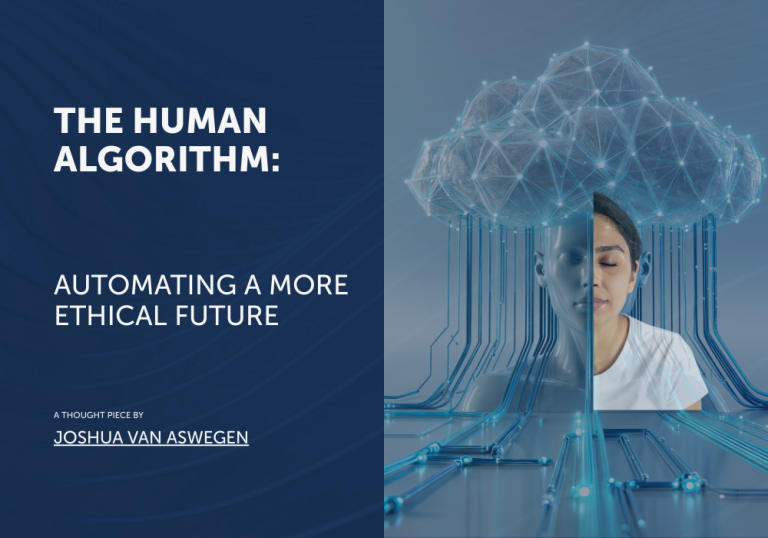
The Human Algorithm: Automating a More Ethical Future

Over the past decade, automation has become one of the most defining forces reshaping how societies function and how economies grow. Artificial Intelligence (AI) and Robotic Process Automation (RPA) are no longer abstract technologies discussed in research papers or confined to film scripts, they have quietly become part of everyday life. From online customer service systems to energy management in global corporations, automation now influences the way people work, communicate, and even make decisions.
The potential benefits of these technologies are enormous, allowing people to focus on more creative or complex tasks. However, this rapid shift toward an automated world also raises important questions about its wider consequences. AI consumes large amounts of energy, contributes to electronic waste, and relies on resource-intensive hardware. It changes the structure of the job market, creating opportunities for some while displacing others, while also impacting the way businesses face accountability for their decisions.
Because of this, discussions about automation can no longer focus only on efficiency or innovation. Rather, they should also address sustainability and responsibility. Companies and policymakers are turning to Environmental, Social, and Governance (ESG) principles and the United Nations Sustainable Development Goals (SDGs) to guide this transformation. These frameworks provide a foundation for understanding how automation can serve not only economic progress, but also environmental protection, fair labour practices, and ethical governance.
This essay explores automation’s environmental and social consequences, while highlighting the growing role of AI and RPA in shaping both challenges and solutions. It argues that automation, if developed and managed responsibly, can become a tool for achieving long-term sustainability. The question is not whether automation will define the future, but whether humanity can guide its development toward outcomes that are equitable, ethical, and sustainable for all.
Environmental Impacts of AI as Automation
With environmental concerns growing worldwide, the impact of artificial intelligence (AI) on the planet is now impossible to ignore. AI systems are often celebrated for their efficiency, creativity, and problem-solving power, but running these massive models comes with real environmental costs. Behind every AI-generated image, chatbot reply, or recommendation algorithm is an energy-hungry infrastructure that keeps it all running.
Recent studies, including one from MIT News, show that data-centre energy demand has exploded in just the past few years, primarily because of AI’s growth. Just in North America alone, total capacity jumped from 2,688 MW in 2022 to over 5,341 MW by 2023. Globally, data centres consumed around 460 terawatt-hours (TWh) in 2022, roughly the same as France’s total consumption. If this trend continues, that number could rise to 1,050 TWh by 2026, making data centres one of the world’s top five power consumers. Since most electricity still comes from fossil fuels, this kind of digital expansion is clearly unsustainable without a major shift toward renewable energy.
Even a single AI model can have a shocking footprint. Training OpenAI’s GPT-3, for example, required about 1,287 MWh of electricity and emitted 552 metric tons of CO₂, enough to drive a car over a million miles, purely to train the model. Every single query to ChatGPT, or to other large models, consumes significantly more power than a normal Google search, about five times more. Multiply that by millions of users and billions of queries, and the scale of energy use becomes enormous.
But it’s not only about electricity. AI systems also demand huge amounts of water to keep their processors cool. According to MIT’s analysis, about two litres of water are used per kilowatt-hour of data-centre energy. In water-scarce regions, this can put major pressure on local supplies and ecosystems. On top of that, manufacturing AI hardware like GPUs depends on rare minerals such as lithium, cobalt, and tungsten, which are mined and processed in energy-intensive ways that also create toxic waste.
And then there’s the growing mountain of electronic waste. As AI hardware evolves so quickly, data centres frequently replace entire racks of GPUs and servers to keep up. One IEEE Spectrum report estimates that AI-related hardware upgrades could generate 2.5 million tons of e-waste each year by 2030. Considering the world produced around 62 million tons in total in 2022, AI could soon account for a sizable chunk of it. This waste contains hazardous materials like lead and mercury, which can pollute soil and water when dumped in landfills, especially in countries without strong recycling systems.
Where RPA Fits In
This is where RPA (Robotic Process Automation) enters the picture. While AI often grabs the spotlight, RPA offers a quieter, more sustainable kind of automation. Instead of training massive neural networks, RPA relies on smaller, rule-based systems that automate repetitive office tasks, things like invoice processing, payroll, compliance checks, or data entry. These systems don’t require vast computing power, which means they consume far less energy and generate less electronic waste.
RPA can also support sustainability goals directly. For example, companies can use RPA bots to automate the collection and reporting of environmental data by tracking energy use, emissions, or supply chain sustainability metrics. This helps organisations meet the reporting requirements of ESG (Environmental, Social, and Governance) standards, which are now becoming central to corporate accountability.
From an SDG (Sustainable Development Goals) perspective, this type of automation supports several of the UN’s key targets, especially SDG 12 (Responsible Consumption and Production), SDG 13 (Climate Action), and SDG 9 (Industry, Innovation, and Infrastructure). RPA can streamline data gathering for sustainability reports, improve energy monitoring in production lines, and reduce paper waste by fully digitising workflows. Basically, RPA shows that automation doesn’t have to come at a huge environmental cost.
When combined thoughtfully, AI and RPA together can create a more balanced approach to digital transformation. RPA can handle predictable, rule-based work while AI focuses on higher-level problem solving, ideally using “green AI” models that are optimised for energy efficiency. Companies integrating both technologies under a strong ESG framework could significantly reduce their environmental footprint while still benefiting from automation.
ESG and Corporate Responsibility
However, all of this depends on corporate decision-making. Most of AI’s environmental impact comes not from individual users but from the choices made by big tech companies. Platforms like X (formerly Twitter), for instance, have built AI chatbots like Grok directly into their user interfaces, making energy-intensive AI usage part of everyday social media behaviour. This creates the illusion that individuals are to blame for rising energy demand, when, rather, corporate-level integration drives the problem.
This tactic echoes what oil companies did decades ago. BP’s famous “carbon footprint” campaign in the early 2000s encouraged people to think about their individual emissions, cleverly distracting from the industry’s much larger responsibility. Today, we see a similar strategy in tech: users are told to “limit prompts” or “reduce screen time,” while corporations keep embedding AI deeper into their infrastructure without transparency about its environmental cost.
This is exactly why ESG frameworks are so crucial. They push companies to measure and disclose their full environmental impact, from data centre emissions to supply chain minerals to hardware disposal. Some major tech firms, like Google and Microsoft, have committed to running their data centres entirely on renewable energy and even becoming carbon negative in the next decade. Commitments such as these align directly with SDG 7 (Affordable and Clean Energy) and SDG 13 (Climate Action).
But these pledges need to be backed by action. RPA tools should be implemented to track compliance, automate sustainability audits, and flag inefficiencies in real time. When RPA is used to monitor ESG progress, it helps ensure that sustainability isn’t just a marketing slogan but a measurable, ongoing process.
Moving Toward Responsible Automation
If we want automation to truly serve humanity rather than harm it, we need a more holistic approach. That means designing AI systems that prioritise energy efficiency, extending the lifespan of hardware, and embracing circular economy principles through recycling and repurposing electronics rather than discarding them. It also means using RPA and AI to make sustainability management itself more efficient, transparent, and data-driven.
Balancing Progress with People
In guiding the development of automation towards a more ethical service, its direct effects on people cannot be ignored. However, this is a tricky subject to approach as the social impact of automation is one of the most debated issues of our time. On one hand, technologies like AI are transforming the way we work, promising higher productivity, fewer errors, and even entirely new kinds of jobs. On the other hand, these same systems threaten to displace millions of workers and deepen social and economic divides.
Economists have long argued that automation ultimately leads to more wealth and, eventually, more jobs. As the Stanford Encyclopaedia of Philosophy points out, productivity growth doesn’t automatically mean job loss. History shows that innovation often creates new opportunities even as it destroys old ones. The invention of the tractor reduced the need for farm labour but led to the rise of the automotive and industrial sectors.
Similarly, today’s automation may eliminate certain office or factory jobs, but it’s also spawning new roles in data analysis, AI ethics, and systems maintenance. The problem isn’t the change itself, it’s the transition, which can be slow, uneven, and painful for workers caught in between.
The Polarised Workforce
Current research suggests we’re entering a new era of labour market polarisation. High-skill jobs, particularly those involving technology, creativity, or complex decision-making, are thriving. Meanwhile, many routine office or manufacturing roles, especially those that involve repetitive tasks, are being automated out of existence. This has created what economists call a “dumbbell-shaped” job market: a concentration of well-paid technical and managerial jobs at the top, a growing pool of low-wage service work at the bottom, and a shrinking middle class in between.
This pattern reflects a phenomenon known as skill-biased technological change. In simple terms, automation increases the productivity of skilled workers while replacing less-skilled ones. As a result, people with technical, analytical, or creative expertise see their value rise while others face declining job security and fewer advancement opportunities. The social outcome is widening income inequality.
How AI and RPA Create (and Save) Jobs
Yet the story isn’t entirely bleak. When designed thoughtfully, AI and RPA can actually enhance human work rather than replace it. For example, Intelligent Automation systems can handle routine data processing while humans focus on strategic decision-making, innovation, or customer relations, tasks that still require emotional intelligence and judgment.
RPA, in particular, represents a more balanced form of automation. Because it handles rule-based, repetitive tasks, such as processing invoices, updating records, or managing compliance forms, it often removes the most monotonous parts of a job rather than eliminating the job entirely. Consulting firms like SmartTechNXT describe RPA as a “digital co-worker” that enhances human capabilities. When companies introduce RPA ethically, they can actually improve employee satisfaction by freeing people from tedious work.
Of course, this doesn’t happen automatically. It requires investment in reskilling and upskilling. A worker who once spent hours entering data into spreadsheets could, with the right training, become a “bot manager,” responsible for supervising RPA workflows or analysing the insights those bots generate. This human–machine collaboration creates a hybrid workforce and can become one that’s more adaptive, efficient, and resilient.
The Human Side of ESG
These transitions highlight why the “Social” pillar of ESG (Environmental, Social, and Governance) is becoming increasingly important. Companies are being held accountable not just for their profits or carbon emissions, but for how they treat their employees and communities. The UN’s Sustainable Development Goals (SDGs), particularly SDG 8 (Decent Work and Economic Growth) and SDG 10 (Reduced Inequalities), call for “inclusive and sustainable economic growth” where automation improves, rather than erodes, job quality.
To meet these goals, companies using AI and RPA need to communicate transparently with workers about upcoming changes, involve them in automation decisions, and invest in their career development. Ethical implementation means making sure people feel part of the process, not victims of it. When handled well, automation can support decent work by removing drudgery and opening doors to new, more creative and fulfilling forms of employment.
UNESCO’s Recommendation on the Ethics of Artificial Intelligence emphasises that human rights and dignity must remain at the core of every technological deployment. For example, the International Labour Organisation (ILO) and other global institutions are now advocating for a human-centred approach to automation. This means ensuring fair labour conditions, preventing discrimination through algorithmic bias, and protecting workers’ privacy as data-driven systems become more common in the workplace. Automation is a deeply social issue, tied to values of fairness, inclusion, and justice.
Governments and corporations also need to consider governance, the “G” in ESG, as part of their automation strategy. Transparent reporting on job impacts, labour diversity, and training investments should become standard practice. This builds trust and aligns corporate goals with global frameworks like the UN SDGs.
The future of automation doesn’t have to pit technology against humanity. When aligned with ESG principles and the UN SDGs, AI and RPA can work together to advance both sustainability and social equity.
Environmentally, automation can transition toward “green AI” models and low-energy RPA systems powered by renewable resources, contributing to a circular digital economy. Socially, automation can empower workers by reducing repetitive labour, creating new hybrid roles, and supporting lifelong learning.
But to achieve this vision, companies must embed sustainability and ethics at the heart of their automation strategies. Governance, the often-overlooked “G” in ESG, plays an important role here. Transparent reporting, stakeholder engagement, and accountable leadership ensure that automation supports long-term well-being rather than short-term profit.
Automation’s story isn’t just about faster algorithms or smarter machines but about the kind of society we want to build around them. If we combine innovation with accountability, technology with empathy, and efficiency with environmental care, automation can become a cornerstone of a more sustainable, fair, and human-centred world.